
Court Exhibits in Another Language: What Actually Gets the Translation Admitted
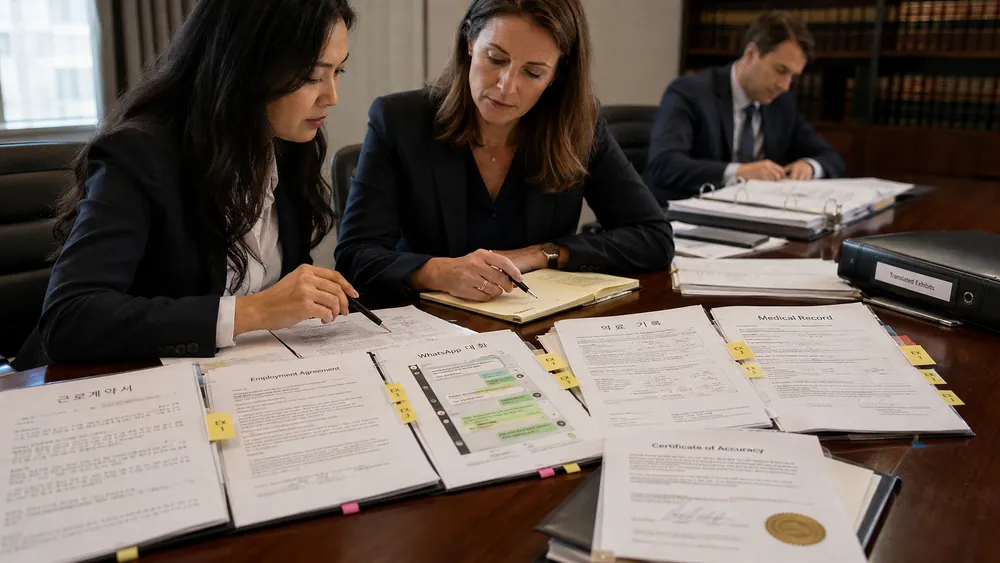
A contract in Korean, a WhatsApp thread in Spanish, a medical record in Armenian. Each of them is evidence, and none of them goes to a jury in that form. The English version is what gets marked, and the English version is a document nobody in the case wrote. That is the part attorneys underweight: the translation is not a clerical step applied to an exhibit, it is a separate item of evidence with its own foundation requirement, and the other side is entitled to test it.
A Translation Is Not Self-Proving
Someone has to vouch for it, under oath, and say who they are.
Under the Federal Rules of Evidence, Rule 901 requires the proponent of an item of evidence to produce evidence sufficient to support a finding that the item is what the proponent says it is. For a translated exhibit, the claim being made is not only “this is the defendant’s contract.” It is also “this English text is an accurate rendering of that contract.” Those are two different claims, and the second is not established by the first.
Rule 604 sets the standard for live interpreters in proceedings: they must be qualified and must give an oath or affirmation to make a true translation. For written translations offered as exhibits, the mechanism is Rule 901. Courts have applied its authentication requirement to translated documents, requiring the proponent to establish the translator’s qualifications and the accuracy of the rendering, by certification or testimony, before the translation comes in.
In practice most translated exhibits come in on a certification rather than live testimony, and most of the time the parties stipulate. The stipulation is a convenience, not a rule. It disappears the moment the other side has a reason to withhold it.
What California Requires
A sworn translator, named on the record.
California Evidence Code section 753 provides that when the characters in a writing offered in evidence cannot be deciphered or understood directly, a translator who can shall be sworn to translate it, and the record shall identify the translator. Compensation is a charge against the court in criminal and juvenile matters, and apportioned among the parties in civil ones.
Two things follow from that text. The translator is a participant in the proceeding, not a vendor whose name appears on an invoice. And “we used a translation service” is not an answer to the question the statute asks, which is who translated it.
What the Certification Has to Say
Enough that a judge could rule on it without calling anyone.
A certification that carries weight names the translator, states their qualifications specifically rather than as an adjective, identifies the source document and the languages in both directions, states that the translation is complete and accurate, and is signed and dated. A certificate of accuracy that says only “certified translation” over a company logo tells the court nothing it can act on.
Two failures show up repeatedly. The first is a certification that attests to accuracy but never establishes competence, so nothing on the page connects the signer to the language pair. The second is an incomplete translation offered as a complete one: excerpts pulled from a longer document, marginalia and stamps left out, a page of handwriting silently skipped. Completeness is part of the assertion, and an opponent who finds the gap has an argument about more than that one exhibit.
Where Translated Exhibits Get Attacked
If you are offering it, the vulnerable points are the translator’s qualifications, the completeness of the rendering, and the handling of terms that do not map cleanly between legal systems. A term of art with no English equivalent, rendered as though it had one, is where a translation stops being a translation and becomes an argument.
If you are opposing it, the first question is who translated it and what they are qualified in. The second is whether the English is complete. The third is whether anyone reviewed it against the original. Withholding a stipulation is cheap, and it forces the proponent to actually lay the foundation.
If the document is going to a jury, it will be read as though it were the original. Juries do not discount translated exhibits for uncertainty. Whatever ambiguity existed in the source language is gone by the time it reaches the box, resolved in whichever direction the translator chose.
Before the Exhibit List Goes Out
Translate the whole document, not the passage you plan to use. Partial translations invite a completeness fight you will lose in front of the jury even if you win it on the record.
Get the certification with the translation, not later. Reconstructing who translated something eight months after the fact is how a routine exhibit becomes a motion.
Have the translator available. Most of the time they will not be needed. The exception is the case where the other side has a reason to fight, and that is precisely the case where you cannot produce someone on short notice.
Decide early whether the translation is contested. If it is, the dispute belongs in a pretrial motion, not discovered on the day the exhibit is offered.
Common Questions
Does a translated exhibit need its own evidentiary foundation?
Yes. Under Federal Rule of Evidence 901 the proponent must support two separate claims: that the original document is what it is said to be, and that the English text is an accurate rendering of it. The second is not established by the first.
Who has to certify a translated exhibit in California?
California Evidence Code section 753 provides that when a writing offered in evidence cannot be understood directly, a translator shall be sworn to translate it, and the record shall identify the translator. Naming a translation company does not satisfy the statute.
What does a certificate of accuracy have to include?
The translator’s name, their specific qualifications rather than an adjective, the source document and both languages, a statement that the translation is complete and accurate, and a signature and date.
Kaplan Interpreting Services provides certified legal translation for exhibits, discovery productions, and filings, with a certificate of accuracy that names the translator and states their credential, and the translator available if the translation is challenged. See also our document translation services and what to check when a translated document crosses a border. Contact us with the language pair, the document type, the volume, and the date the exhibit list is due.
Not legal advice. Evidentiary standards vary by jurisdiction. Verify the current text of the applicable rule.

CEO & Founder
Born in Dallas, Texas, Alexandra grew up surrounded by Spanish, English, Arabic, and Italian. After moving to Venezuela, Spanish became her primary language. She holds a Master's in Healthcare Administration from Washington University in St. Louis and is a California court certified and medical interpreter.
She founded Kaplan Interpreting Services after seeing an industry that treated interpreters as interchangeable and clients as ticket numbers. She built a protocol-driven operation where every interpreter is hand-selected and credentialed for the specific setting, every client has a dedicated point of contact, and risk management is built into every assignment.
Her career reached a historic milestone when she interpreted the conversation between President-elect Biden and Pope Francis. That assignment, along with engagements for Nike and the Summit of the Americas, set the standard for every client engagement that followed.
"The same protocols that protected that historic conversation now protect every assignment we handle."